
List of aquatic invasive species in Nova Scotia
These aquatic invasive species have been seen in Nova Scotia. For each species, the following information is shown:
- name
- species type (biological category)
- habitat type
- freshwater: lakes and rivers with little to no salt content
- marine: oceanic areas with high salt content
- terrestrial: on land. In this case, areas next to water.
- known locations in Nova Scotia
- Distributions of freshwater species in the table are described with reference to counties, and marine species distributions reference marine subregions. Observation within a county or subregion does not mean the species is found throughout it.
- Note: the full distributions of aquatic invasive species are often unknown. A lack of observation within a particular area does not mean the species is absent from that area, just that it has not been observed there.
- pathways of introduction and spread (how aquatic invasive species arrive or spread as a result of human activities)
- If multiple pathways are listed, an asterisk (*) indicates likely mode of initial introduction, if known.
- impacts (to the natural environment, humans, and the economy)
- Not all impacts have necessarily been observed in Nova Scotia. Some impacts may remain unknown.
This list does not include microscopic species (phytoplankton, zooplankton, and other microorganisms) that cannot be observed with the naked eye.
If you think you’ve discovered an aquatic invasive species, contact us to report it.
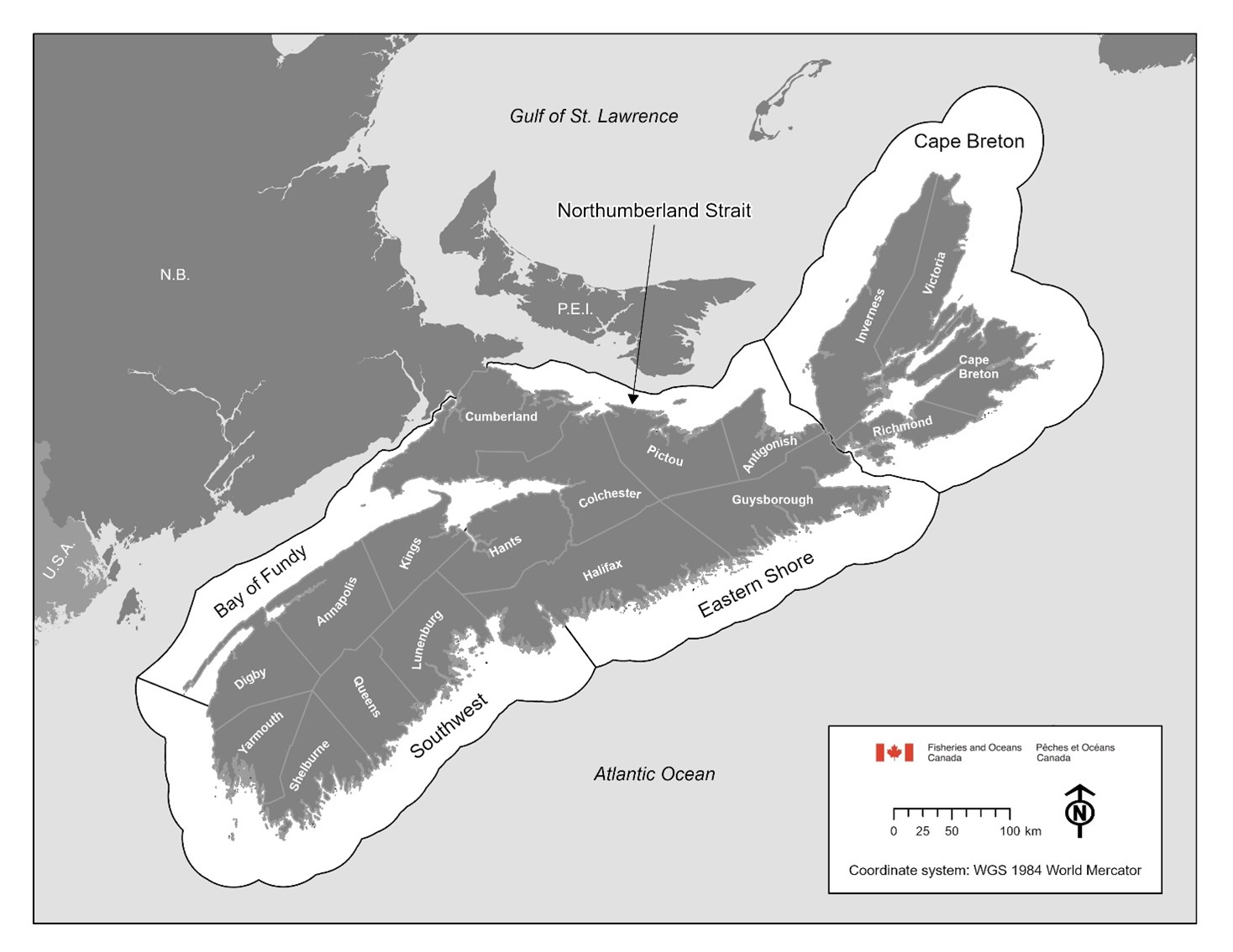
Image long description
- Shelburne
- Yarmouth
- Digby
- Queens
- Annapolis
- Lunenburg
- Kings
- Halifax
- Hants
- Colchester
- Cumberland
- Guysborough
- Pictou
- Antigonish
- Richmond
- Inverness
- Cape Breton
- Victoria
The coastal waters of Nova Scotia are divided into the following subregions:
- Bay of Fundy
- Southwest
- Eastern Shore
- Cape Breton
- Northumberland Strait
Aquatic invasive species in Nova Scotia
| Species Name | Species Type | Habitat Type(s) | Known Locations in Nova Scotia | Pathways of Introduction and Spread | Impacts |
|---|---|---|---|---|---|
|
Carolina fanwort (Cabomba caroliniana) |
Plant |
Freshwater |
Frog Pond, Halifax |
|
|
|
Chain Pickerel (Esox niger) |
Fish |
Freshwater |
Most watersheds throughout Nova Scotia except the northeast of the province (Guysborough, Antigonish, Cumberland counties) and most of Cape Breton |
|
|
|
Bivalve shellfish |
Freshwater |
Occurrences concentrated in Halifax Regional Municipality, but scattered occurrences have been noted throughout the rest of the province |
|
|
|
|
Flowering Rush (Butomus umbellatus) |
Plant |
Freshwater |
Gribble
Scattered occurrences throughout Nova Scotia |
|
|
|
Fish |
Freshwater |
Distribution unclear, but have been observed in freshwater lakes throughout the province, including in the Halifax Regional Municipality, the Annapolis Valley, and Cape Breton |
|
|
|
|
Koi (Cyprinus rubrofuscus) |
Fish |
Freshwater |
Distribution unclear, but scattered reports from throughout Nova Scotia (e.g. in Halifax Regional Municipality) |
|
|
|
Crayfish |
Freshwater |
Yarmouth County |
|
|
|
|
Red Swamp Crayfish (Procambarus clarkii) |
Crayfish |
Freshwater |
Three Mile Lake, Halifax Regional Municipality |
|
|
|
Fish |
Freshwater |
Many watersheds throughout southern and central Nova Scotia, with the exception of the northeast mainland and parts of Cape Breton |
|
|
|
|
Spinycheek Crayfish (Faxonius limosus) |
Crayfish |
Freshwater |
Freshwater Lake (Cape Breton) |
|
|
|
Plant |
Freshwater |
Scattered occurrences in ponds around the province, most notably in Little Albro Lake, Dartmouth |
|
|
|
|
Common Reed (Phragmites ssp. australis australis) |
Plant |
Freshwater Terrestrial |
Throughout Nova Scotia |
|
|
|
Yellow Iris (Iris pseudacorus) |
Plant |
Freshwater-Terrestrial |
Occurrences concentrated in Halifax Regional Municipality, but scattered occurrences have been noted throughout the rest of the province. |
|
|
|
Crab |
Marine |
Bay of Fundy, Southwest |
|
|
|
|
Bonnemaison's Hook Weed (Bonnemaisonia hamifera) |
Seaweed |
Marine |
Bay of Fundy; Cape Breton; Eastern Shore; Northumberland Strait; Southwest |
|
|
|
Tunicate |
Marine |
Bay of Fundy; Cape Breton; Southwest |
|
|
|
|
Bryozoan |
Marine |
Bay of Fundy; Cape Breton; Eastern Shore; Northumberland Strait; Southwest |
|
|
|
|
Tunicate |
Marine |
Bay of Fundy; Southwest; Cape Breton |
|
|
|
|
Crab |
Marine |
Bay of Fundy; Cape Breton; Eastern Shore; Northumberland Strait; Southwest |
|
|
|
|
Tunicate |
Marine |
Bay of Fundy; Cape Breton; Southwest |
|
|
|
|
Tunicate |
Marine |
Bay of Fundy; Cape Breton; Eastern Shore; Northumberland Strait; Southwest |
|
|
|
|
Narrow-Leaved Cattail |
Marine |
Bay of Fundy; Cape Breton; Eastern Shore; Northumberland Strait; Southwest |
|
|
|
|
Japanese Wireweed (Sargassum muticum) |
Seaweed |
Marine |
Southwest |
|
|
|
Orange-Striped Green Anemone (Diadumene lineata) |
Anemone |
Marine |
Bay of Fundy; Southwest |
|
|
|
Seaweed |
Marine |
Cape Breton; Eastern Shore; Northumberland Strait; Southwest |
|
|
|
|
Tunicate |
Marine |
Bay of Fundy; Southwest |
|
|
|
|
Ribbed Bryozoan (Juxtacribrilina mutabilis) |
Bryozoan |
Marine |
Cape Breton; Eastern Shore; Northumberland Strait; Southwest |
|
|
|
Siphoned Japan Weed (Dasysiphonia japonica) |
Seaweed |
Marine |
Cape Breton; Eastern Shore; Southwest |
|
|
|
Toothed Rockweed (Fucus serratus) |
Seaweed |
Marine |
Cape Breton; Eastern Shore; Northumberland Strait; Southwest |
|
|
|
Tufty-Buff Bryozoan (Tricellaria inopinata) |
Bryozoan |
Marine |
Southwest |
|
|
|
Twisted Sea Tubes (Melanosiphon intestinalis) |
Seaweed |
Marine |
Bay of Fundy; Southwest |
|
|
|
Tunicate |
Marine |
Bay of Fundy; Cape Breton; Eastern Shore; Northumberland Strait; Southwest |
|
|
|
|
Tunicate |
Marine |
Bay of Fundy; Cape Breton; Eastern Shore; Northumberland Strait; Southwest |
|
|
Note: Where multiple pathways are listed, an asterisk (*) indicates likely mode of initial introduction, if known.
Pathways of introduction and spread
There are many ways for aquatic invasive species to arrive or spread as a result of human activities. Pathways for the aquatic invasive species that have been observed in Nova Scotia are described here.
Release
- The transportation and intentional release of a species, with minimum human assistance after release. For example, the release of a sport fish for future angling.
- This pathway can be further broken down into:
- Stabilization and barriers (plants introduced to stabilize soil and control erosion)
- Fishery in the wild (species introduced to establish wild populations for future angling)
- Other release (species introduced to establish wild populations for another reason)
Escape
- The escape of a species from a confined or controlled environment. For example, dumping unwanted pets into a waterbody.
- This pathway can be further broken down into:
- Aquaculture (aquaculture animals or plants establishing wild populations)
- Pet (unwanted or escaped aquarium animals)
- Horticulture (aquatic plants grown for commercial sale)
- Ornamental (aquatic plants for ornamental purposes, such as for use in ponds)
- Live food (species transported to be sold as food)
- Live bait (species used as live bait for fishing purposes)
Contaminant
- The introduction of a species through the movement of other species or organic materials. For example, the movement of shellfish that are contaminated with invasive tunicates for aquaculture.
- This pathway can be further broken down into:
- Contaminant of animals (species introduced because they are attached to or associated with transported animals, such as aquaculture animals)
- Seed contaminant (plant seed accidentally mixed with other seed and transported)
Stowaway
- The introduction of species as a stowaways or hitchhiker on human-made materials. For example, the overland movement of an aquatic plant caught on a boat propeller. Contaminant: The introduction of a species through the movement of other species or organic materials. For example, the movement of shellfish that are contaminated with invasive tunicates for aquaculture uses.
- This pathway can be further broken down into:
- Fishing equipment (species introduced because they are attached to or on fishing equipment, such as nets and clothing)
- Watercraft excluding ballast water or hull fouling for vessels sized >24m (species transported on non-wetted areas of large vessels)
- Machinery and equipment (species introduced because they are attached to industrial machinery or equipment, such as aquaculture equipment)
- Packing material (species accidentally included and transported in packing material, such as seaweed or straw)
- Ballast water (species introduced because they are carried in ballast water, which is used to control the buoyancy and stability of ships)
- Biofouling (species introduced because they are attached to the outside surfaces of ships and boats)
In addition to human-mediated pathways, aquatic invasive species also have some capacity for natural spread. For example, invasive species can spread through swimming or as larvae or fragments floating in the water.
Learn more about pathways of introduction and spread.